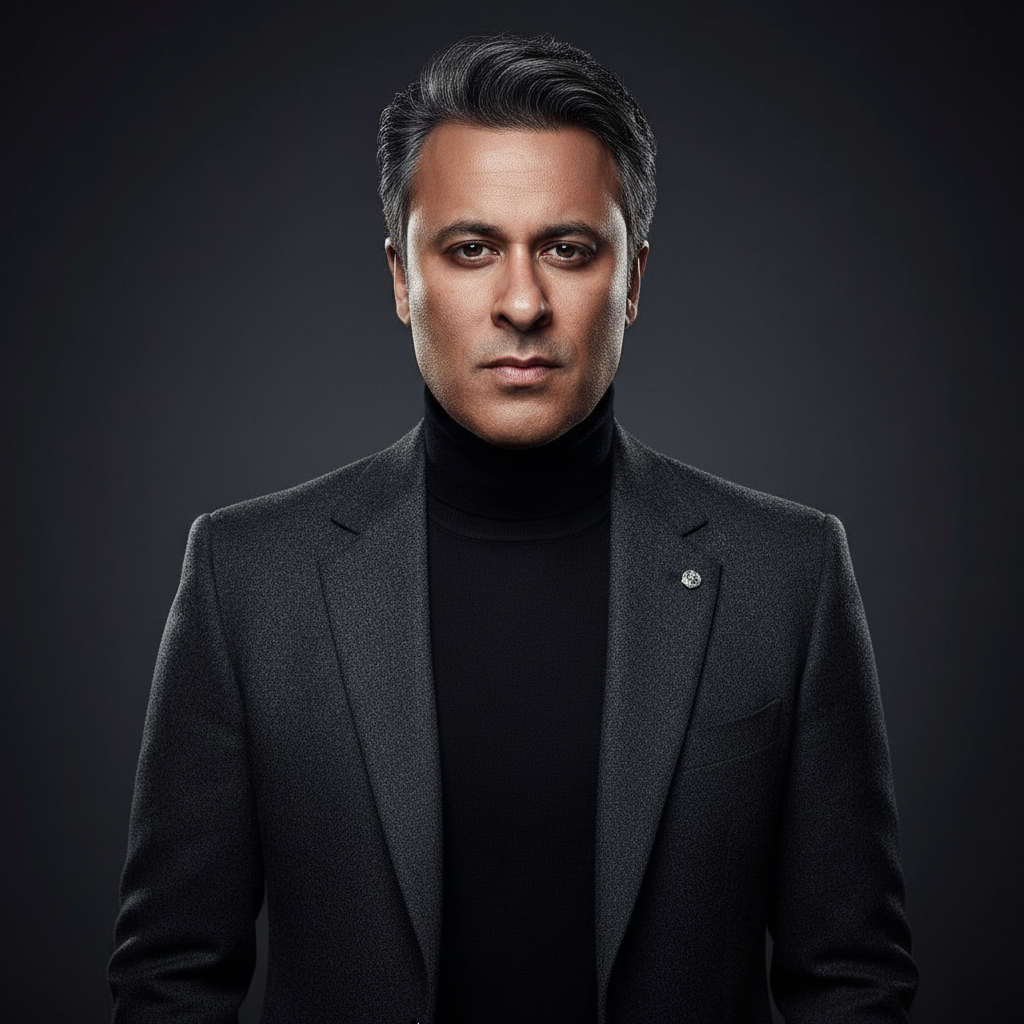
The Author
Rishi Khiani
Direct descendant of the Khiani family. Sixth generation. Mumbai.
How a family of grain merchants from Hyderabad, Sindh built the world's first retail multinational, 96 cities on five continents across a century of world history, and why they made sure nobody noticed.
"In 1922, Howard Carter announced the discovery of Tutankhamun from the steps of the Winter Palace Hotel in Luxor. Down the corridor, a shop called Pohoomull Brothers had been open for sixty-four years.
Agatha Christie wrote Death on the Nile in the same hotel. King Farouk took his afternoon tea one floor above the family's arcade. Edward VIII, newly abdicated, walked into their store with Wallis Simpson, and the family closed the doors for him.
In 1923, an earthquake destroyed their shop and factory in Yokohama in five minutes. In 1947, a man left Sindh on a train with a bag of diamonds.
Nobody wrote about any of this. The family never asked to be written about.
That was rather the point. The question this book asks is whether that was genius or tragedy. The answer is both."
The House of Pohoomull is the untold story of the most consequential Indian merchant dynasty in history: a family from Hyderabad, Sindh who built the world's first retail multinational across 96 cities on five continents, operated for a hundred years, and did it so quietly that history forgot to notice them.
Beginning as grain merchants, the Khiani family, trading as Pohoomull Brothers, were in Egypt before the Suez Canal opened, in Japan before any other Sindhi firm, in Malta before any other Indian trader. They declined a partnership from Thomas Cook and watched him build the hotel that housed their shop. They were appointed Royal Jewellers to two Egyptian kings. Edward VIII walked into their Gibraltar store with Wallis Simpson, and the family closed the doors. They ran the world's first encrypted global communications network, maintained double-set ledgers in a script no British revenue collector could read, and invented the offshore structure a century before the term existed. They funded Indian independence while carrying British passports. When freedom finally arrived, it came as partition, erasing the homeland that held the network together.
A coat bearing their label surfaced at an estate sale in Pennsylvania a century later. A £35,000 Art Deco necklace in a fitted Pohoomull case sold at Bonhams. A $9,700 gold pin engraved with their name sits in a New York dealer's case. A 1909 registered letter from their Manila branch to Algiers, listed by a French philatelist as "route rare", proves the network was operating in real time across hemispheres. Agatha Christie wrote two novels in the same year from the hotel that housed their arcade. The evidence is everywhere. Nobody followed the trail.
In 2025, Zara is called the most sophisticated retailer in the world. The Pohoomull Brothers did what Zara does, 130 years earlier, without computers, without container ships, and without credit. The astrologer who named the firm said seven generations of wealth. This is the story of what those seven generations built, and what happened when the count ran out.
The academic foundation exists: Claude Markovits’s Cambridge University Press study documents the Khiani family extensively. The archive is recoverable and verifiable: auction lots at Bonhams, photographs in the Australian War Memorial, court records across four continents, garments surfacing in vintage markets from Pennsylvania to Paris.
But the urgency is not archival. The history of globalisation is being rewritten, away from Ferguson-style imperial triumphalism, toward the decentred narratives that actually built the modern economy. The Pohoomull Brothers are the missing chapter in that rewriting: a non-European, non-colonial trading network that predated, outperformed, and outlasted the institutions the textbooks credit. The last generation of living family memory is passing. The Gibraltar store, open since the 1890s, is still run by a Khiani descendant. In 2023, the City of Yokohama restored the Indian water tower in Yamashita Park, a hundred years after the earthquake that destroyed the neighbourhood it commemorates. The world is starting to remember this history without knowing the full story. The global conversation about whose capitalism built the modern world has never been more urgent. This book answers it with a family.
Rishi Khiani is a direct descendant of the Pohoomull Brothers: sixth generation, Mumbai. He has spent a lifetime carrying a story no one in the family asked to have written. He has insider access to living family members across Mumbai, Gibraltar, and the global Sindhi diaspora, and to an archive that has never been opened to an outside researcher. He is also the former CEO of Times Internet, India’s largest digital media company, and founder of Kaam.com and Fork Media Group, a media publisher operating across seven countries.
From grain merchants to royal jewellers, spies to silk traders: the story of the family that built the world's first retail empire, and vanished without a trace.
The coat exists. You can look it up.
A 1920s silk garment, cream-coloured, embroidered with appliqués and Shisha mirror work, found at an estate sale in Pennsylvania. The label, intact after a hundred years: Pohoomull Bros, Oriental Costumes and Textiles, Luxor (Egypt), Winter Palace Bldgs.
The coat was not made in Egypt. The silk was not Egyptian. It was bought, designed and moved across two continents by a family from Hyderabad, Sindh, whose shop had been in Luxor since 1858, and in the arcade of the Winter Palace Hotel since the day the hotel opened. They outlasted Howard Carter. They outlasted the Egyptian monarchy, the British Empire, two world wars, and the century that tried to forget them.
Nobody wrote about the Pohoomull Brothers.
That was, as we will see, entirely deliberate.
At their peak, the Pohoomull Brothers ran ninety-six branches across five continents, sourced globally, designed in-house, and coordinated it all through a private intelligence network, without computers, without container ships, without a single word of English in their ledgers. They called themselves merchants, and the whole operation, simply, the firm.
For a hundred years, the firm’s strategy was silence. The ledgers were kept in a script no outsider could read. The shops bore a trading name, not the family’s own. The money moved without banks. The evidence is everywhere. Nobody followed the trail.
The stories survive anyway, passed from father to son in the back rooms of shops, carried in voices across the water, worn thin by retelling but never quite lost. A boy in Bombay heard them from his father, who had heard them from his. I was that boy. I did not know yet what to do with them.
The coat is just the door.
End of Prologue · The House of Pohoomull
An American collector posts a photograph online. A label on a 1920s silk coat reads: Pohoomull Bros, Oriental Costumes and Textiles, Luxor (Egypt), Winter Palace Bldgs. She has no idea what it means. In the comments, a man in Mumbai leaves a message using the URL of his tech startup. He is a direct descendant. The coat found him before he found it. He is the author of this book.
The prologue establishes what the book will prove: for a hundred years, the Pohoomull Brothers left traces everywhere: a coat, a ring, a 1909 registered letter from Manila to Algiers, a sign in an Australian War Memorial photograph, a $9,700 gold pin in a New York dealer's case. Nobody thought to follow the trail. This book does.
The British annex Sindh in 1843 and believe they have taken everything. They have accidentally given something far more useful: British subjecthood: a passport for everywhere, a key to every treaty port on earth. The Khiani family. Grain merchants. Five brothers. A family pandit is summoned. His advice: name the firm after Pohoomull, not the most active brother, simply the one the stars favour. Seven generations. The brothers agree. They name their empire after a man who will not lead it. The astrologer's clock starts ticking.
Young boys in the firm are not sent to traditional schools. They are inducted. Taught two things: complex mental arithmetic, and the Hataie Akhar, the Hatvaniki script, specifically to handle the secret business books. Nothing else. No history. No literature. The firm is its own school. The curriculum is commerce and encryption. The degree it awards is invisibility. These boys will grow up to run branches in Yokohama and Gibraltar and Manila, keeping double ledgers in a script no authority on earth can read, remitting money home to a city they will see for six months every three years.
Back in Hyderabad, while the men are gone, the women run everything. Not informally. Completely. They manage households, raise children, make decisions, hold communities together for years at a stretch. The mansions are built around them. Every window on a facade tells the city how far the man of the house has gone and how much he has sent back. What grows from this enforced matriarchy (architecturally, spiritually, culturally) is Chapter 9's story. The men built an empire. The women, in the space the empire left behind, built something that outlasted it.
A colonial conquest accidentally creates the passport for everywhere. A family of grain merchants reads the fine print, and in building an empire from it inadvertently creates the conditions for a matriarchy that will reshape Indian spiritual life.
The ship. The English passengers returning home. The young man from Hyderabad with a bundle of embroidered cloth and an insight so simple it will drive a hundred-year empire: the same object exists in two markets simultaneously: one where it is ordinary, one where it is extraordinary. The distance between them is simply water.
Sahijram Khiani arrives in Luxor in 1858, eleven years before the Suez Canal opens. He does not wait for the infrastructure. He is already there when it arrives.
The greatest feat of 19th century engineering is anticipated by a family from Sindh who are already in position when the first ship passes through.
Thomas Cook offers a partnership. The family declines. Cook then participates in building the Winter Palace Hotel in Luxor, and the Pohoomull Brothers open a shop in its arcade. The man who was turned down builds the building that houses his would-be partners.
The Bombay Apollo Bunder store is operating simultaneously at the highest level of the city's jewellery trade. A British ex-serviceman named Collins targets it specifically, the most prestigious jewellery address in Bombay, using the family's reputation as his cover story to buy a pearl necklace worth £5,000 with a fraudulent cheque. The Washington Times covers the trial. Professional conmen do not waste elaborate cover stories on modest establishments.
Across Durban, South Africa, the family is simultaneously fighting the colonial Dealer's Licenses Act in court. Three continents of litigation at once. The firm keeps trading through all of it.
Thomas Cook, the man who invented modern tourism, builds the showcase of the family that turned him down. The family's reputation is so prestigious that a Bombay conman uses it as currency.
The Hatvaniki script, also called Hataie Akhar, was the encryption system that made everything possible. A specialised merchant shorthand so specific to the Sindhi trading community that even untrained family members could not decipher it. British tax collectors could not read it. Competitors could not read it. Combined with a private telegraphic codebook in which a single invented word encoded a complex conditional trade instruction, it gave the family something no government on earth possessed: a genuinely secure global communication channel. A branch in Panama knew silk prices in Yokohama within hours. This is the nineteenth century. There is no telephone.
But the script is also architecture. Two sets of accounts: one in English or Arabic-Sindhi for the official gaze, the true ledger in Hatvaniki for internal use. Japan could not tax what Britain protected. Britain could not audit what Hatvaniki concealed. The family existed in the gap between two empires: visible to both, legible to neither. This chapter reconstructs how they built the world's first offshore structure, a century before anyone gave it a name, and follows the money trail from the treaty ports to the independence movements the family was quietly financing from every corner of the network.
An unreadable script. An untraceable ledger. An empire used as infrastructure by the people quietly dismantling it from the inside.
The family establishes itself in Yokohama in the 1870s among the very first Indian firms in the treaty ports. They do not merely trade Japanese silk; they specialise in Habutai, a lightweight plain weave, and become so dominant in its global distribution that they help define the international market for it. The silk in Parisian couture houses in the 1920s passes through Pohoomull hands first. By 1937, the Pohoomull network is the primary funnel for Japanese textiles into Southeast Asia, Africa, and the Americas. When Chinese merchants boycott Japanese goods during the Second Sino-Japanese War, the Pohoomull network steps in: sixty years of Japanese relationships allow them to become the dominant exporters of Japanese goods to the rest of the world. Every disruption in the system creates an opportunity for a family embedded in all parts of it simultaneously.
The human cost of this machine is the bachelor messes. Young men, boys trained in mental arithmetic and Hatvaniki script instead of going to school, sent to Japan for three years at a time. They live in communal quarters in Yamashita-cho, keeping secret ledgers in a country whose language they do not speak, for a firm whose secrets they carry in a script their Japanese neighbours cannot read. A life of separation and loneliness. They remit everything home. They return to Hyderabad for six months. Then they go back. This is the three-year exile. This is the human engine beneath the silk empire.
September 1, 1923. 11:58 AM on a Saturday. Magnitude 8.0. Yokohama smashed. The Indian neighbourhood of Yamashita-cho obliterated. Twenty-three Indians dead, including nine children. The shop gone. The factory gone. Fifty years in five minutes. And then: they walk to Kobe. The Japanese government builds sixteen two-storey wooden houses specifically to bring the Indian merchants back. The family returns. A cousin visits Japan a century later. The Khiani name is still recognised in the old trading district.
The deadliest natural disaster in Japanese history destroys fifty years of work in five minutes. The response is to walk to the next city and start again. The silk the family moved helped define global fashion. The men who moved it lived alone in foreign countries, keeping secrets in a script no one around them could read.
The sample chapter tells the Egypt story from the coat inward. This chapter tells it from the wars outward. The Great War. Soldiers marching past the Cairo shopfront on their way to Gallipoli, frozen in an Australian War Memorial photograph. The interwar years: Farouk's court, the royal jewellers appointment, the afternoon teas one floor above the arcade. The family photograph with Jawaharlal Nehru during one of his visits to Egypt in the 1950s: the Pohoomull family standing with the Prime Minister of the country whose independence their money had helped buy.
By 1945, the Cairo workshop is producing fine jewellery at the highest level. A French gold ruby-and-emerald pin, currently in a New York dealer's case at $9,700, bears the Pohoomull name engraved on its reverse. Nasser's revolution comes. The colonial world unwinds. The family stays through all of it, until 1970, when the uncle managing the Egypt operation dies and there is nobody willing to cross the water and take his place. Not politics. Not revolution. A single absence. The longest-running Indian enterprise in Egypt ends not with a decree but with an empty chair.
Two world wars, a revolution, and the end of a monarchy. The family outlasts them all, and closes not because of history but because of the one thing history cannot replace: a person.
November 1921. Edward, Prince of Wales, arrives in Valletta to open the Maltese Parliament. He walks down Kingsway past the Pohoomull Brothers store, the first Indian shop in Malta, established thirty-four years earlier. The Indian merchant community decorates its shops for his visit.
Fifteen years later, newly abdicated, he returns to the Mediterranean with Wallis Simpson, the most famous stateless couple in the world. They come to the Gibraltar store. The family closes the doors. He stays.
Two kinds of stubbornness recognising each other across a counter. A king who chose love over power. A family that chose independence over Thomas Cook's partnership. Both stateless, in their different ways. Both free.
The most-watched royal drama of the 20th century walks into a shop built by a family that built an empire without a crown, without a country, without anyone's permission.
The governor of Gibraltar notes in 1938 that Main Street has been nicknamed "Bombay Street." The westward expansion from Gibraltar into the Canary Islands, Morocco, South America and Panama is so complete it has acquired its own colonial geography. A hundred Sindhi merchants in the Canary Islands alone. Sixty in Tenerife. The family is among the four big firms operating across Spanish territory when Franco fires the first shot.
The Spanish Civil War freezes everything. Assets seized. The family cannot leave, cannot move merchandise, cannot withdraw money. Both the Nationalists and Republicans view the Hatvaniki script, the same encryption system that protects them from British tax collectors, as a Fifth Column red flag. A group of foreigners communicating in an unbreakable code, in a country at war, paranoid about espionage. The same script. Two entirely different problems.
And meanwhile, stranded and under surveillance, these merchants are still moving money eastward: the same independence remittances documented in Chapter 4, now routed through Franco's Spain. British passports, unbreakable code, an enemy's territory. The moral architecture is vertiginous. After Franco wins, the family pivots completely: suspected spies become essential economic partners of the regime, primary suppliers of luxury goods to an isolated, famine-stricken economy. The very script that branded them as enemies becomes their commercial shield. By the 1970s, Sindhis own over 200 businesses in Ceuta and Melilla. They became indispensable to the man who had accused them of espionage.
The script that branded them as spies becomes the shield that saves them. Trapped by Franco, funding Indian independence, becoming essential to the Franco regime: a family that survived by being indispensable to whoever won, whatever side they were on.
The chapter takes us home, to the home that no longer exists as home. The Khiani Mansion in Hyderabad Sindh, still standing in Pakistan. The nerve centre where every remittance from Cairo and Yokohama and Malta was settled each year. The number of windows on the facade was a direct mark of status: each window telling the city exactly how successful the global operation was. Rabindranath Tagore called Hyderabad the most fashionable city in India. He was describing what these men built and sent home.
The mansions were built for the women who ran them, not the men who were rarely there. Jharokas, enclosed balconies with perforated screens, allowed the women to observe street life without being seen, because the men were in Egypt and Japan for three years at a time. These women managed households, raised children, made financial decisions, held communities together across years of absence. They were not wives waiting. They were administrators of a distributed system. Out of this enforced matriarchy, in the 1930s, the Om Mandali spiritual movement grew among the women of the Bhaiband community, during the long absences. It became the Brahma Kumaris. It now operates in more than a hundred countries. The men built a commercial empire. The women, in the space the empire left behind, built a spiritual one.
And the kitchen. Every three years, a man came home from Yokohama or Cairo and the household began eating macaroni, agar-agar, jellies and custards, foods exotic elsewhere in India. The Sindhi kitchen was globalised by the musafri cycle decades before globalisation was a word. One woman broke every rule: Phuliwari, the one who wears a nose ring, wife of Naraindas Pohoomull, was the first woman to accompany her husband overseas. A descendant remembers her as a beautiful fair lady. She crossed the water the women were not supposed to cross. The Khiani Mansion is still standing in Pakistan. Neither it nor the family who built it belong to the same country anymore.
A mansion built with the profits of five continents stands in a country that did not exist when it was built. The women who ran it founded a global spiritual movement. The kitchen was the first thing they globalised.
Two dissolutions, sixteen years apart. The 1931 Arbitration Award splits the unified empire among five sons of Khiamal: Pohumal, Sahijram, Moolchand, Valiram, Lekhraj. One firm becomes five. The internal family turmoil that follows is the crumbs story: branches diverging, fortunes separating, the later generation pampered by inherited comfort, unable to rebuild what the founders built, fighting over what remains of something that was once too large to fight over. The Great Depression compresses the tourist trade simultaneously. The family survives by becoming smaller. No employees are fired: solidarity over efficiency, the Bhaiband way. The astrologer said seven generations. The fractures are beginning in the fourth.
And here is the chain that nobody followed to its end. The independence movement the family helped fund from Cairo and Yokohama and the Canary Islands (the Ghadar Movement, the INA, the merchant money quietly paving the road to freedom) arrives in August 1947. And it arrives as partition.
The division runs along religious lines, and the line places Hyderabad Sindh inside Pakistan. The city where all the accounts were settled. Where all the remittances flowed. Where the Khiani Mansion stands. Inside a country the family did not vote for and cannot stay in. They funded the movement that produced the event that destroyed the centre of the network. The branches had survived earthquakes and world wars and civil wars. What they could not survive was the loss of the centre. Not because it was economically essential. Because it was the idea. The place the money went home to. When it ceased to be home, the network lost its reason to hold together. They had funded their own ending. The Quetta riots. The Karachi riots. Christmas Day 1947: all Hindus to leave Sind. The chapter builds toward one image that carries everything.
They funded their own liberation. Their liberation arrived as partition. The partition erased the centre that held everything together. This chain is real, documentable, and nobody has said it plainly until now.
A man leaves Sindh on a train in 1947 with a bag of diamonds. A global empire compressed into what fits in his hands.
Bombay as the rebuilt life. The Valsons dyeing mills. The store called Hiranand Valiram, named after the author's great-grandfather. The Red Gate shop, positioned where the British steamers docked, the same formula the family had used for a century: be where the customer arrives. A new city, the same instinct.
And the one operation that never closed: Gibraltar. Markovits arrives in 1992, is received by Mr L. Khiani with great kindness, and writes his name in the acknowledgements of a Cambridge University Press book. The scholar comes to the last keeper of the empire. He is given tea.
An empire that spanned five continents ends not in a declaration but in a man on a train. The sixth generation rebuilds it as a digital storefront, putting Cairo on the list without knowing why Cairo feels right.
The astrologer set a clock. A Khiani sits down to write the book the family never asked to have written, because the clock has run out, and the silence it kept is no longer his to carry.
The House of Khiani.